

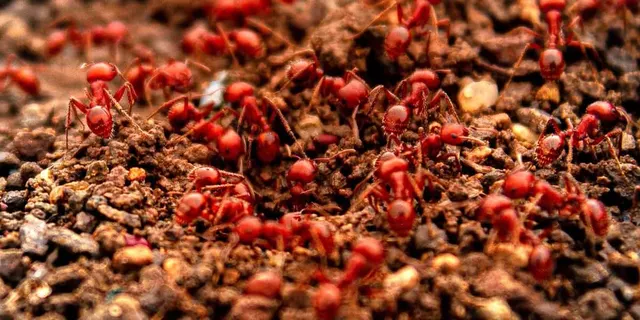
Why Do I Have Fire Ants On My Austin Property?
What draws fire ants to a Central Texas yard in the first place, and the conditions that keep them there.
Read post →Dogs and cats meet fire ants nose-first. They stumble onto mounds while exploring, and unlike us they cannot always get clear before the swarm boils out. A serious fire ant attack on a pet means intense pain, possible allergic reaction, and sometimes a genuine medical emergency. Here is what every Central Texas pet owner should know.
Spotting the mound before your pet does is step one. Central Texas mounds vary a lot, but these are the tells:
| What to check | What fire ants show you |
|---|---|
| Size | Anything from an inch-high bump to three feet tall, depending on colony age |
| Location | Open lawns, gardens, and landscaping, often popping up after rain as colonies rebuild near the surface |
| Entrances | Several entry and exit points, not one central hole like most other ants |
| Base activity | Small holes around the base mean workers are actively foraging |
| Below ground | Deep tunnel networks connecting multiple mounds |
That underground network is why plugging one entrance or dumping water on a mound rarely accomplishes anything. The colony shifts a few feet over, rebuilds, and your pet is right back at risk.
Pets carry more fire ant risk than most owners realize:
If fire ants attack your pet, get them away from the area immediately, brush off every ant you can find, and call your veterinarian, especially at any sign of an allergic reaction.
You can knock the risk down considerably in the areas your pets use most:
The honest caveat: in Central Texas, prevention alone often is not enough. Fire ant colonies here are persistent and everywhere, and when pets are involved, which product gets used and how it gets applied matters for their safety. That is where professional treatment earns its place.
Hardware-store fire ant products carry real risk around animals. Many use broad-spectrum chemicals that can harm dogs and cats that walk treated ground too soon, or that snuffle up granules while investigating the yard, which is exactly what dogs do.
A licensed technician instead will:
Accurate Termite & Pest Control serves pet-owning households throughout Austin, Cedar Park, Leander, Round Rock, Lago Vista, Liberty Hill, and the surrounding area. See our full service area or our home pest control plans.
Your pets are counting on you to keep their territory safe, and waiting for an attack is the wrong way to find out how bad the mounds are. We offer pet-safe fire ant treatments across the Austin metro, backed by over 25 years protecting Central Texas families, furry members included. We also run commercial pest control for kennels, veterinary offices, and other pet-friendly businesses where animal safety comes first.
Contact us or call (512) 267-0812 for a free inspection and a fire ant plan that is safe for the whole family.
Quick answers
Get them away from the mound right away and brush off any ants still on them, because fire ants keep stinging as long as they are attached. Rinse the area with cool water and watch for allergic signs: swelling beyond the sting site, vomiting, labored breathing, or sudden lethargy. Any of those means call your veterinarian immediately.
When a licensed technician handles the application, professional treatments are chosen with household pets in mind, and your tech will tell you how long to keep animals off treated areas, usually a short window after application. Always mention your pets before treatment starts so the right products and methods get used.
Colonies are not always visible. Mounds hide under mulch, leaf litter, and dense grass. Watch for disturbed soil near landscaping, worker ants crossing pavement or patios, and your pet suddenly fixating on, or avoiding, one particular spot. A professional inspection is the reliable way to find hidden colonies early.
It happens, usually through foundation cracks or gaps around utility lines, and especially after heavy rain floods the outdoor colonies. Fire ants showing up inside, particularly near pet food or bedding, should be handled promptly by a licensed professional.
Fire ant pressure in Central Texas runs year-round, so most pet owners do best on a recurring plan, typically every 3 to 6 months depending on the property’s history and risk. Ask us about ongoing fire ant service plans that keep the yard consistently protected.
More posts
What draws fire ants to a Central Texas yard in the first place, and the conditions that keep them there.
Read post →
Why fire ants hit Austin yards so hard, what a sting really does, and the treatment approach that actually reaches the queen.
Read post →
Faster response, real knowledge of Central Texas pests and conditions, and honest pricing. Why a local Austin pest control company beats a national chain.
Read post →If you’re dealing with termites, rodents, or ongoing pest issues, our team is here to help. Call today to schedule an inspection or get a free estimate.