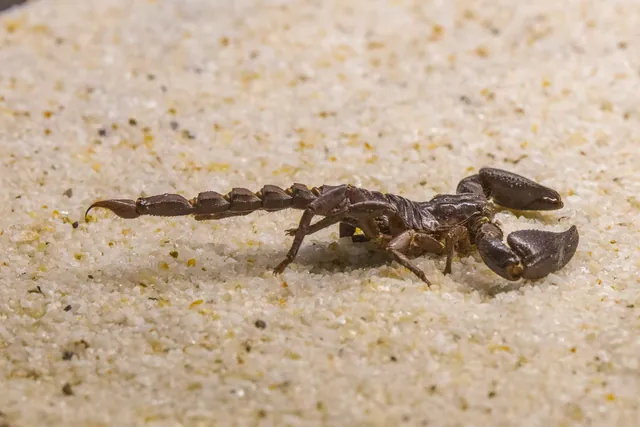
Texas does not have an official scorpion season, but striped bark scorpions are most noticeable during hot, dry summers, when they move toward houses looking for water and cooler temperatures. They are active at night, and they can turn up inside any time a gap under a door or a crack in the wall lets them follow that cooler air.
The striped bark scorpion is the most common and widespread scorpion in Texas, and it is the one you are almost certainly finding in a Leander or Austin home. Here is how to identify it, when and why it comes inside, what its sting actually does, and what keeps it out.
When Is Scorpion Season in Texas?
You will see plenty of specific months and temperature cutoffs online, but those numbers mostly come from Arizona desert research, not Texas. What Texas A&M AgriLife entomologists describe is a pattern tied to weather:
- Hot, dry stretches push scorpions indoors. In heat and drought they look for water and cooler spots, and they will squeeze in wherever they feel the temperature difference, under a door or through a crack.
- Heat moves them within the house, too. Scorpions already living in an attic may come down into the living areas to escape the heat up there.
- They avoid extremes. Scorpions do not seem to like either very cold or very hot temperatures, which helps explain why a shaded house looks inviting in the middle of a Texas summer.
- They hunt at night. Scorpions hide during the day and come out after dark, which helps them manage heat and water loss. Porch and landscape lights draw the insects they feed on, so a lit entryway can become a nightly buffet.
Winter slows them down rather than wiping them out. The striped bark scorpion is freeze-tolerant, so a cold snap does not clear out an established population.
How Do You Identify a Striped Bark Scorpion?
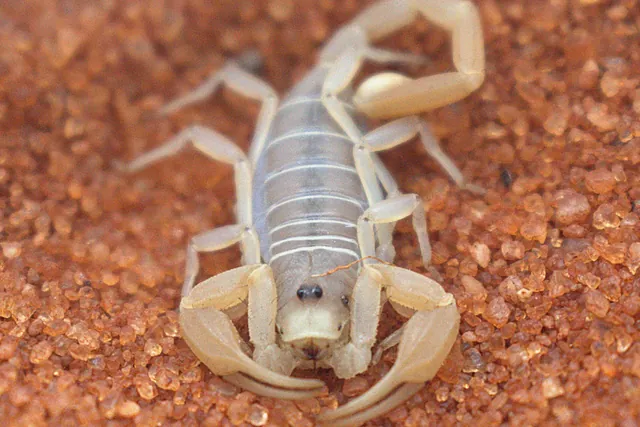
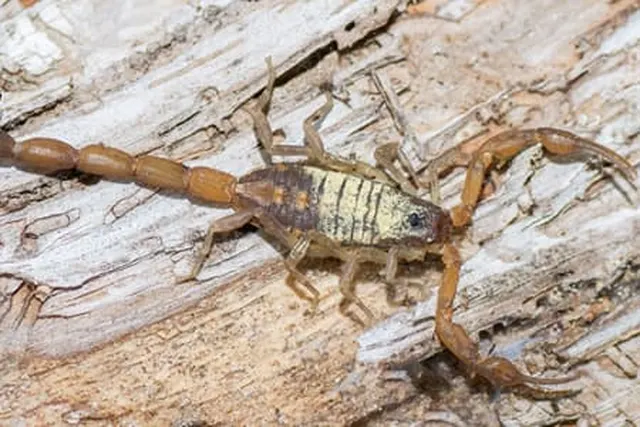
The striped bark scorpion (Centruroides vittatus) is easy to recognize once you know what to look for:
| Feature | Striped bark scorpion |
|---|---|
| Size | About 2.5 inches long as an adult |
| Color | Yellowish tan with two broad dark stripes running down the back |
| Head | A dark triangular mark on the front of the head |
| Pincers | Long and slender, not the thick crab-like claws of some other scorpions |
| Tail | Long and thin. Males have noticeably longer tails than females |
| Where found | Under rocks, boards, and debris, in trees, on walls, and often in attics |
Texas has 18 scorpion species, but the striped bark scorpion is the only one found statewide. Around the Balcones Escarpment, including parts of the Austin area, you may also run into the Texas cave scorpion, a darker species that lives in caves and limestone crevices. For a closer look at both, see our scorpion identification guide.
Why Are Scorpions Getting Into My House?
Usually for one of three reasons: water, shelter, or food. Striped bark scorpions do not burrow. They live under things, like rocks, landscape timbers, woodpiles, and leaf litter, and a house with those right against the foundation gives them a short walk to the door.
They are also strong climbers. Striped bark scorpions climb trees and vertical walls easily, and branches that touch the roof give them a bridge into the attic. They generally do not make it far across a horizontal ceiling, but an attic is exactly the kind of dark, undisturbed space they settle into. And because they eat insects, spiders, and centipedes, a house with a bug problem is a house with a scorpion food supply.
One more thing that surprises people: scorpions have very low metabolic rates, and some species can survive for months without eating. You cannot simply starve them out.
Are Striped Bark Scorpions Dangerous?
No scorpion in Texas is considered deadly. The only scorpion in the United States of real medical concern is the Arizona bark scorpion, a different species that is not found in Central Texas.
That does not make a striped bark scorpion sting pleasant. Expect pain, swelling, itching, numbness, and some discoloration around the sting, lasting anywhere from several minutes to several days. For most people it is a moderate reaction. Young children, older adults, and anyone allergic to the venom are at higher risk and should be watched closely.
First aid for a scorpion sting
This follows guidance from the Texas Poison Center Network and Texas A&M AgriLife. We are pest control professionals, not medical providers, so call a doctor or poison center with any questions.
- Wash the sting with soap and water.
- Apply a cool compress or ice pack.
- Call the Texas Poison Center Network at 1-800-222-1222.
- Call 911 or go to the emergency room for trouble breathing, a spreading rash, or swelling and pain that keep getting worse.
How Do You Find Scorpions at Night?
Scorpions glow blue-green under ultraviolet light, and the University of Arizona notes you can spot one from several yards away with a UV flashlight. Walk the foundation, fence lines, and woodpiles after dark, and never look directly into the UV light. Where you find them gives you a good idea of where they are living.
How Do You Keep Scorpions Out of Your House?
Texas A&M is clear that scorpions are hard to control with insecticides alone, because they spend the day tucked into crevices where sprays do not reach. The approach that works starts outside the walls:
- Clear their hiding spots. Move rocks, boards, bricks, and firewood away from the foundation, keep grass short near the house, and never store firewood indoors.
- Trim the bridges. Prune tree branches and shrubs back so they do not touch the roof or walls.
- Seal the gaps. Weather strip doors and windows, keep screens tight, and seal around pipes and eaves.
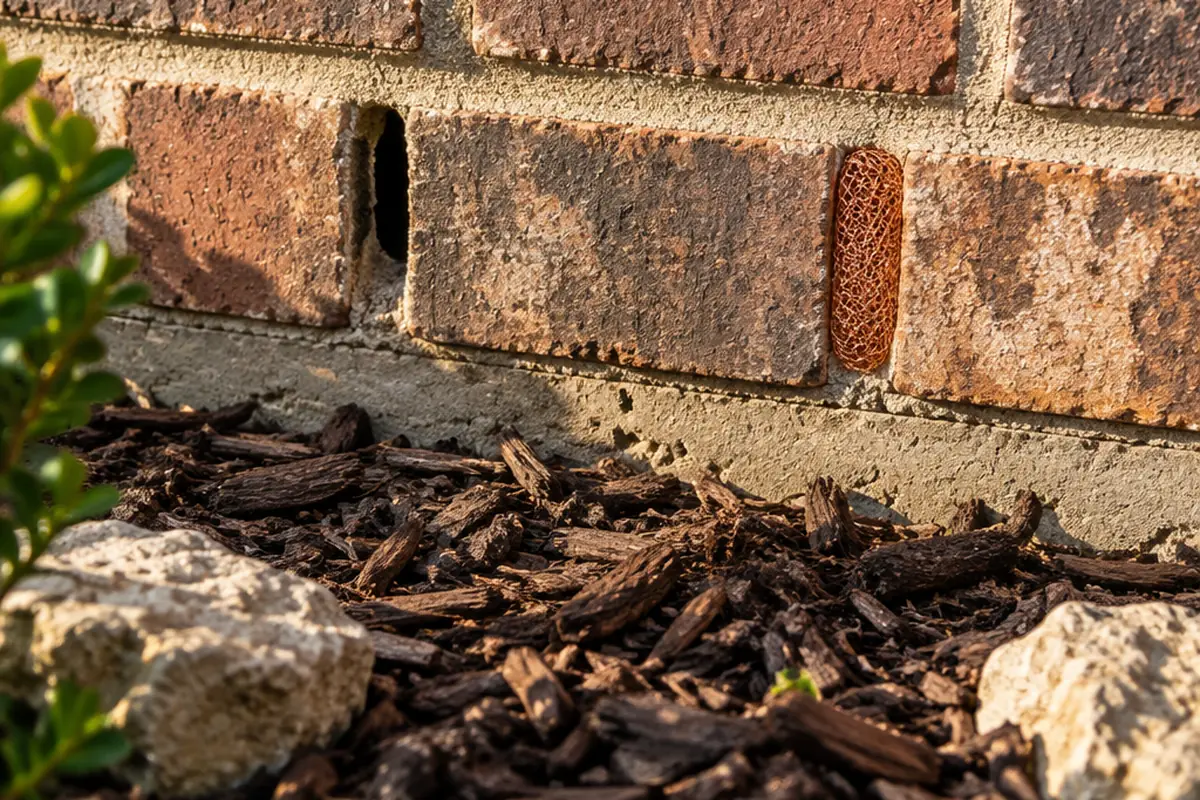
- Screen the weep holes. Brick homes have small openings near the bottom of the wall that let moisture escape. They should be screened, not sealed shut, so the wall can still breathe.
- Cut the food supply. Fewer insects around the house means fewer reasons for scorpions to hang around, and cutting back on outdoor lighting at night means fewer insects gathering by the doors.
- Treat where they live. Perimeter treatments around the foundation and dusts in attics and wall voids reach the places scorpions actually hide.
That is the same plan behind our scorpion control service. It starts with a monthly perimeter treatment around the outside of the house, because a treatment that fades in the Texas heat is not protection. We add attic dusting to reach the dark spaces a liquid treatment cannot, and exclusion work: we plug weep holes with copper mesh, which keeps scorpions out while still letting the walls breathe, and we weather strip exterior doors. See scorpion control in Leander or scorpion control in Austin, or call (512) 267-0812 for a free estimate.
Sources
- Texas A&M Field Guide to Common Texas Insects: Striped bark scorpion
- Texas A&M AgriLife Extension: Scorpions
- Texas A&M AgriLife Today: Pests indoors on the rise as Texas heat and drought continue
- Texas A&M School IPM: Action plan for bark scorpions
- Texas Parks and Wildlife Magazine: Texas scorpions
- Texas Poison Center Network: Venomous critters
- University of Arizona Cooperative Extension: Scorpions
- University of Missouri Extension: Scorpions