What Are the Best Termite Prevention Tips in Austin?
Moisture control, smarter landscaping, barrier treatments, and regular inspections: the five termite prevention strategies that protect Austin homes.
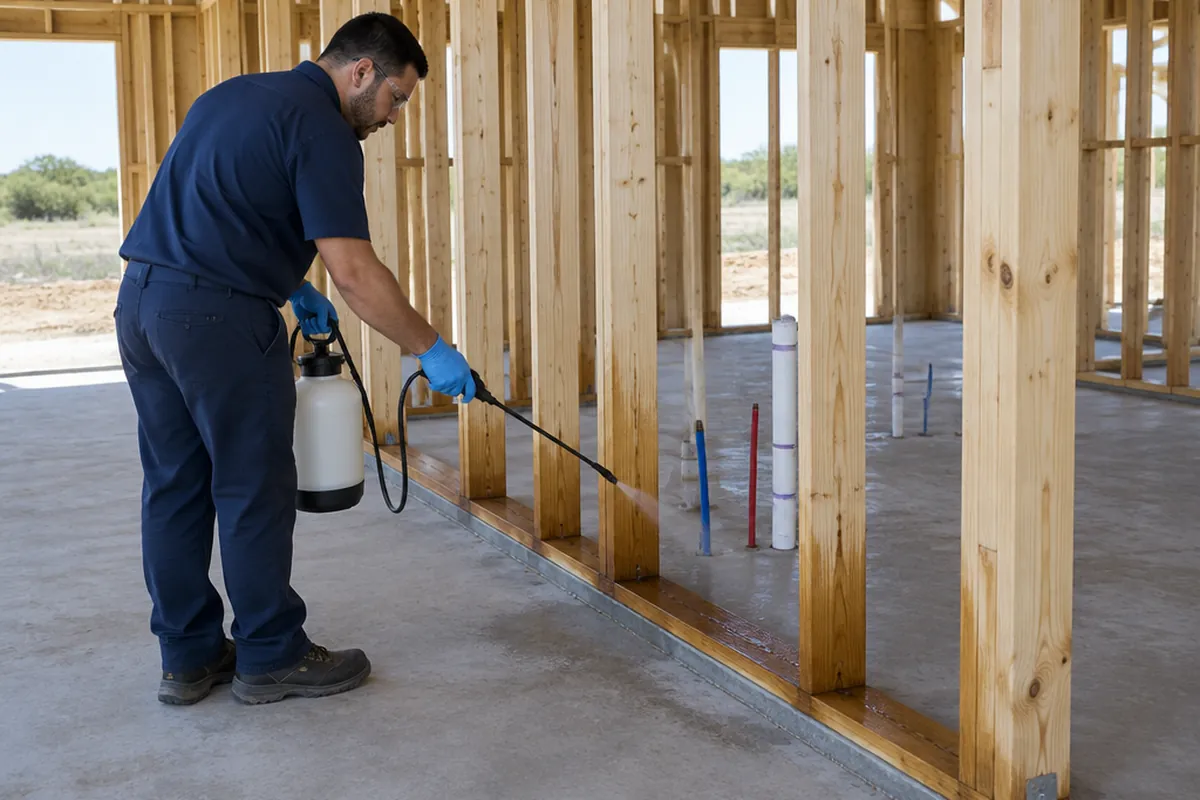
Read post →Bora-Care is a borate wood treatment for termites: a liquid sprayed onto bare lumber that makes the wood itself toxic to termites and other wood-destroying insects. It works best at the framing stage of a new home, before the walls are closed in, and it only protects bare wood that stays dry.
That makes it one of the most useful tools for protecting a new build in Central Texas, and the wrong tool for most existing homes. Here is what Bora-Care is, how a pre-construction treatment is done, how long it lasts, and where its limits are.
Bora-Care is made by Nisus Corporation and registered with the EPA (Reg. No. 64405-1). Its active ingredient is disodium octaborate tetrahydrate, a borate salt at 40 percent. Borates are compounds of boron, a naturally occurring element. The rest of the concentrate is a glycol-based carrier.
Borates work as a stomach poison. Termites that feed on treated wood take in the borate and die, but it is slow-acting and does not repel them. In one laboratory study, more than 90 percent of Formosan termites feeding on borate-treated material died within 16 days. The Bora-Care label covers subterranean termites (including Formosan), drywood and dampwood termites, carpenter ants, powderpost and other wood-boring beetles, and the decay fungi that cause wood rot.
For a slab-foundation home, the label spells out the pre-construction treatment in detail:
The timing matters more than most homeowners realize. Once drywall, paint, or sealer goes on, Bora-Care can no longer reach the wood. The treatment window on a new build is a few weeks at the framing stage.
Texas rules specifically allow this approach. Under the Texas Administrative Code (4 TAC §7.173), a borate treatment of the framing can be used in place of a full soil treatment for a new home, as long as it reaches at least 2 feet up from the slab and the product label covers bath traps and plumbing penetrations. Bora-Care’s label does both.
As long as the wood stays dry. The label describes treatment as permanent provided the treated wood is not exposed to rain, moisture, or ground contact, and University of Florida IFAS puts protected borate treatment at 10 years or more, stable for the life of the lumber when it is kept out of the weather. In long-term field research, borate-treated lumber kept out of the rain performed as well as traditional pressure-treated wood after ten years.
The catch is water. Borates dissolve, so repeated rain, standing water, or soil contact washes them out of the wood. That is why Bora-Care is used on interior framing and not on fence posts or deck footings.
They solve different problems. The right choice depends mostly on whether the walls are still open:
| Feature | Bora-Care | Termidor |
|---|---|---|
| What gets treated | The wood itself | The soil around and under the foundation |
| Best timing | New construction, at the framing stage | Existing homes, or as a soil treatment |
| Active ingredient | Disodium octaborate tetrahydrate (borate) | Fipronil |
| How it works | Termites that eat treated wood die over days to weeks | Termites cannot detect it, pass through it, and spread it through the colony |
| Main limitation | Needs bare, dry wood that stays dry | Needs access to the soil around the structure |
For a house that is already built, Texas A&M notes that borate sprays offer only partial protection, because so much of the wood is covered. That is where a soil treatment like Termidor, the number one conventional termite treatment in the U.S., does the heavy lifting.
If you are building a new home, our pre-construction termite treatments protect it from the start. We perform stud and foundation treatments, and our stud treatments use Bora-Care to treat the wood from the bottom plate up, along with the plumbing penetrations. Pre-construction treatments come with a five-year warranty.
For existing homes, we inspect first and then treat with Termidor around the perimeter, backed by a one-year warranty that is renewable yearly. Both services are part of our termite control in Leander and termite control in Austin. Building soon? Call (512) 267-0812 before the drywall goes up, while the framing is still bare. To learn how subterranean termites get into Central Texas homes in the first place, see our termite identification guide.
Quick answers
Texas rules allow a borate treatment of the framing in place of a full soil treatment, as long as it reaches at least 2 feet up from the slab and covers bath traps and plumbing penetrations. Our pre-construction service combines stud and foundation treatments and carries a five-year warranty.
Only on bare, unsealed wood you can reach. In a finished home most framing is behind drywall, so Texas A&M notes borate sprays give only partial protection. For existing homes, a soil treatment like Termidor is the standard.
For as long as the treated wood stays dry. The label calls the treatment permanent when the wood is not exposed to rain, moisture, or ground contact, and University of Florida IFAS puts it at 10 years or more in protected wood.
No. It is a slow-acting stomach poison. Termites that feed on treated wood die over the following days to weeks, which is why it is best used to prevent damage rather than to knock out an active infestation.
It has low acute toxicity compared with many pesticides, but it is not non-toxic. The label carries a CAUTION signal word and requires protective gear during application, and no one should be in the treated area until the spray has soaked into the wood.
More posts
Moisture control, smarter landscaping, barrier treatments, and regular inspections: the five termite prevention strategies that protect Austin homes.
Read post →
Termites can quietly drain the value of an Austin property. What buyers, sellers, and homeowners need to know about inspections, treatment, and prevention.
Read post →
Swarm timing, the signs of an active colony, and the prep that keeps termites from settling in.
Read post →If you’re dealing with termites, rodents, or ongoing pest issues, our team is here to help. Call today to schedule an inspection or get a free estimate.