Austin's Fire Ant Problem
Why fire ants hit Austin yards so hard, what a sting really does, and the treatment approach that actually reaches the queen.
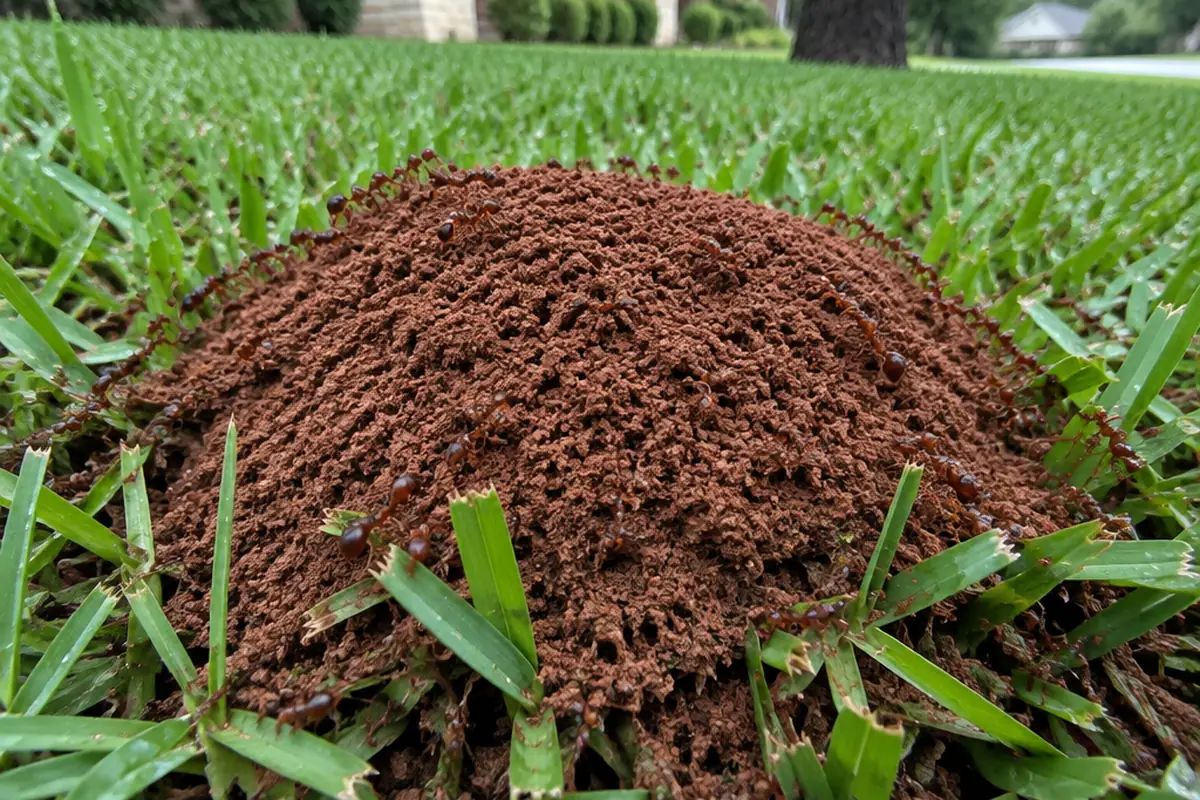
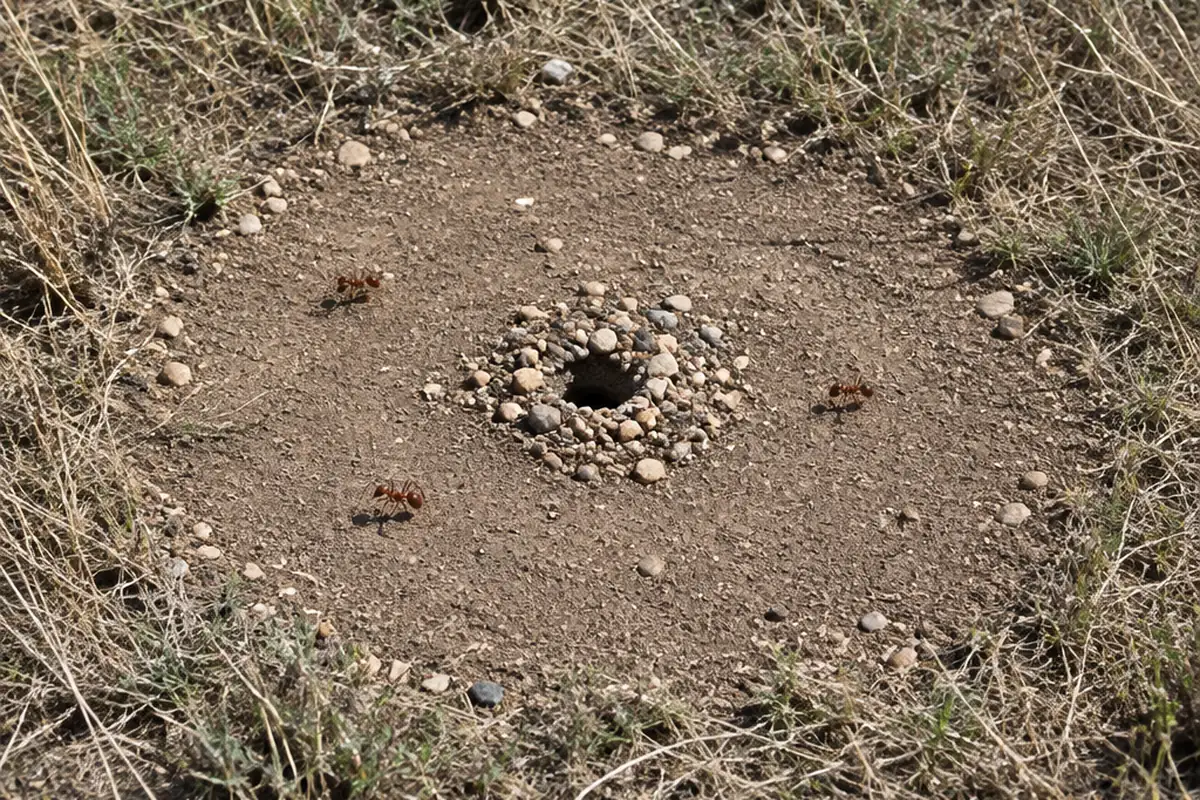
Read post →In Texas, “red ants” usually means one of two very different insects: the red imported fire ant, an invasive pest that stings in swarms, or the red harvester ant, a bigger native ant that mostly leaves people alone. The fastest way to tell them apart is the nest. Fire ants build fluffy dirt mounds with no opening on top, while harvester ants clear a bare circle of ground with a single hole in the middle.
The difference matters, because one belongs on your treatment list and the other usually does not. Here is how to identify each, what they have in common, and what to do about the ones in your yard.
The red imported fire ant (Solenopsis invicta) is native to South America. It arrived in the U.S. through the port of Mobile, Alabama, around the 1930s, reached Texas in the 1950s, and made it to Austin around 1980. It now covers roughly the eastern two-thirds of the state.
Workers are small, about 1/16 to 3/16 inch long, reddish brown with a darker rear end, and they come in mixed sizes within the same colony. Texas also has native fire ants. The tropical fire ant (Solenopsis geminata) is common in Central Texas, and it looks and behaves much like the imported species. Everything below about mounds, stings, and treatment applies to both.
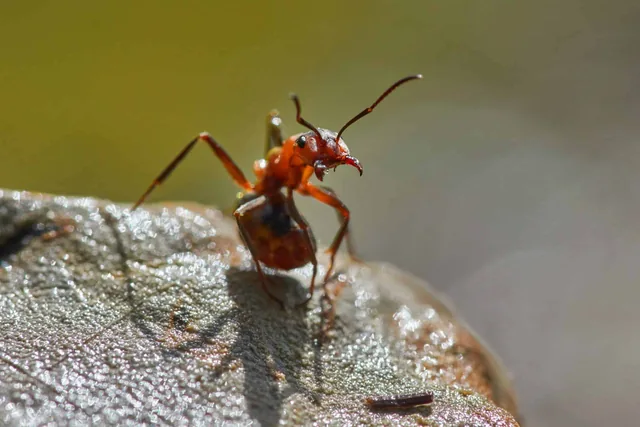
The red harvester ant (Pogonomyrmex barbatus) is a native Texas ant and the one most people mean when they say “big red ants.” Workers are 1/4 to 1/2 inch long, uniformly red to dark brown, with large square heads, and every worker in the colony is about the same size.
Harvester ants collect seeds and dead insects, and they clear the vegetation around their nest into a bare disk that is usually several feet across. They are far less common in Texas than they were a century ago, and that decline worries wildlife biologists: harvester ants are a main food of the threatened Texas horned lizard, which can eat 70 to 100 of them a day.
| Feature | Fire ant | Red harvester ant |
|---|---|---|
| Nest | Dome of loose, worked soil, often in lawns and along sidewalks | Flat, bare circle of cleared ground |
| Entrance | No opening on top. Ants come and go through underground tunnels | One obvious hole in the center, often ringed with pebbles |
| Worker size | 1/16 to 3/16 inch, mixed sizes in one colony | 1/4 to 1/2 inch, all about the same size |
| Color | Reddish brown with a darker abdomen | Uniform red to dark brown, square head |
| When disturbed | Pour out fast and run up anything vertical, including your leg | Generally reluctant to attack |
| Origin | Invasive, from South America (imported species) | Native to Texas |
| Treat it? | Yes, especially near play areas, pets, and walkways | Usually no. Texas A&M suggests leaving them alone |
Start with the nest, since you can check it from a safe distance:
Then watch the ants. Fire ants swarm the moment a mound is disturbed, and you will see workers of noticeably different sizes. Harvester ants are larger, all one size, and much less interested in you. Texas A&M also notes that other small ants get mistaken for fire ants, including bigheaded ants and odorous house ants (the ones that smell like rotten coconut when crushed).
Both sting, and both stings hurt. The difference is how they deliver it.
A fire ant grips your skin with its jaws and stings with the tip of its abdomen. Because the stinger is not barbed, one ant can sting over and over, and dozens of ants can be on you before you feel the first one. Within a day or two, each sting usually forms a small white pustule. About 1 percent of people are hypersensitive to fire ant venom, and even people without an allergy can have a severe reaction to a large number of stings at once.
A harvester ant sting is also genuinely painful, and its effects can spread along the lymph channels. The saving grace is behavior: harvester ants rarely go looking for a fight, so stings mostly happen to someone who sits or stands right on a nest.
Fire ants, yes. Texas A&M’s recommended approach is the Two-Step Method: a broadcast bait across the whole yard, which foragers carry back to the colony over the following weeks, plus a fast-acting treatment on individual mounds that are causing problems right now. Timing matters. Bait works when ants are actively foraging, roughly when the soil is between about 65°F and 90°F, and it should go down on dry ground with no rain expected for a day or two. In Central Texas, spring and late August through early October are ideal windows.
Our fire ant control service follows the same two-level logic. On smaller lawns we treat around the mounds themselves. On larger properties, or when mounds are spread across the yard, we treat the entire lawn instead of chasing individual colonies. Either way the service comes with a one-year warranty: if fire ants come back during the year after treatment, we come back and re-treat at no additional cost.
Harvester ants, usually no. They are native, they are not considered a serious pest, and Texas A&M recommends considering not controlling them at all. Broadcast fire ant baits also kill harvester ants, sometimes more efficiently than they kill fire ants, so avoid spreading bait near a harvester colony you want to keep. If a harvester nest is right beside a patio or a spot where kids play, call us and we will talk through options with you honestly.
Not sure which you have? For the other ants that show up around Central Texas homes, see our ant identification guide, or call (512) 267-0812 for a free inspection from our Leander or northwest Austin office.
Quick answers
Not necessarily. “Red ants” is a nickname, not a species. In Texas it usually refers either to fire ants or to red harvester ants, which are larger native ants with a very different nest and temperament.
Both hurt. Fire ants are the bigger problem around most homes because they swarm and each ant can sting repeatedly, often dozens at a time. A single harvester ant sting can be more painful, but harvester ants rarely attack unless you are right on their nest.
Rain collapses the colony’s underground tunnels, and the ants push the soil up to rebuild, which creates a fresh, visible mound. The colony was already there. The rain just makes it obvious.
Usually not. They are native, not considered a serious pest, and an important food for the threatened Texas horned lizard. Texas A&M recommends considering leaving them alone unless a nest is in a spot where stings are likely.
Spring and early fall, from late August through early October, are ideal because the ants are actively foraging. Bait works best on dry ground when no rain is expected for a day or two.
More posts
Why fire ants hit Austin yards so hard, what a sting really does, and the treatment approach that actually reaches the queen.
Read post →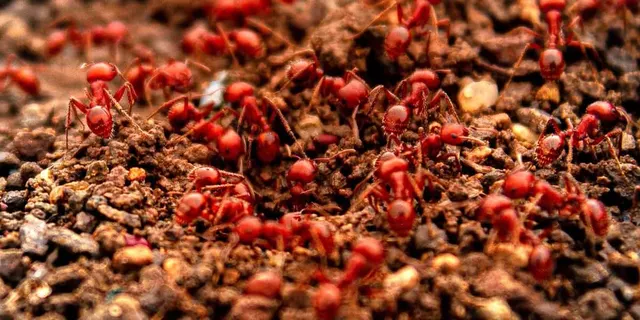
What draws fire ants to a Central Texas yard in the first place, and the conditions that keep them there.
Read post →
Fire ant stings put curious dogs and cats at real risk. How to protect the yard and what to do after a sting.
Read post →If you’re dealing with termites, rodents, or ongoing pest issues, our team is here to help. Call today to schedule an inspection or get a free estimate.